Organization settings
What belongs to the club rather than to one event: its logo, the address your players reply to, the account that collects the money, your tax numbers and your plan. Set once, at the start, and rarely touched again.
It all lives on one page: inside your organization, open Settings. It reads in four parts — your organization, the members, collecting registration fees, your SetRally subscription — and each group says in one line where it stands.
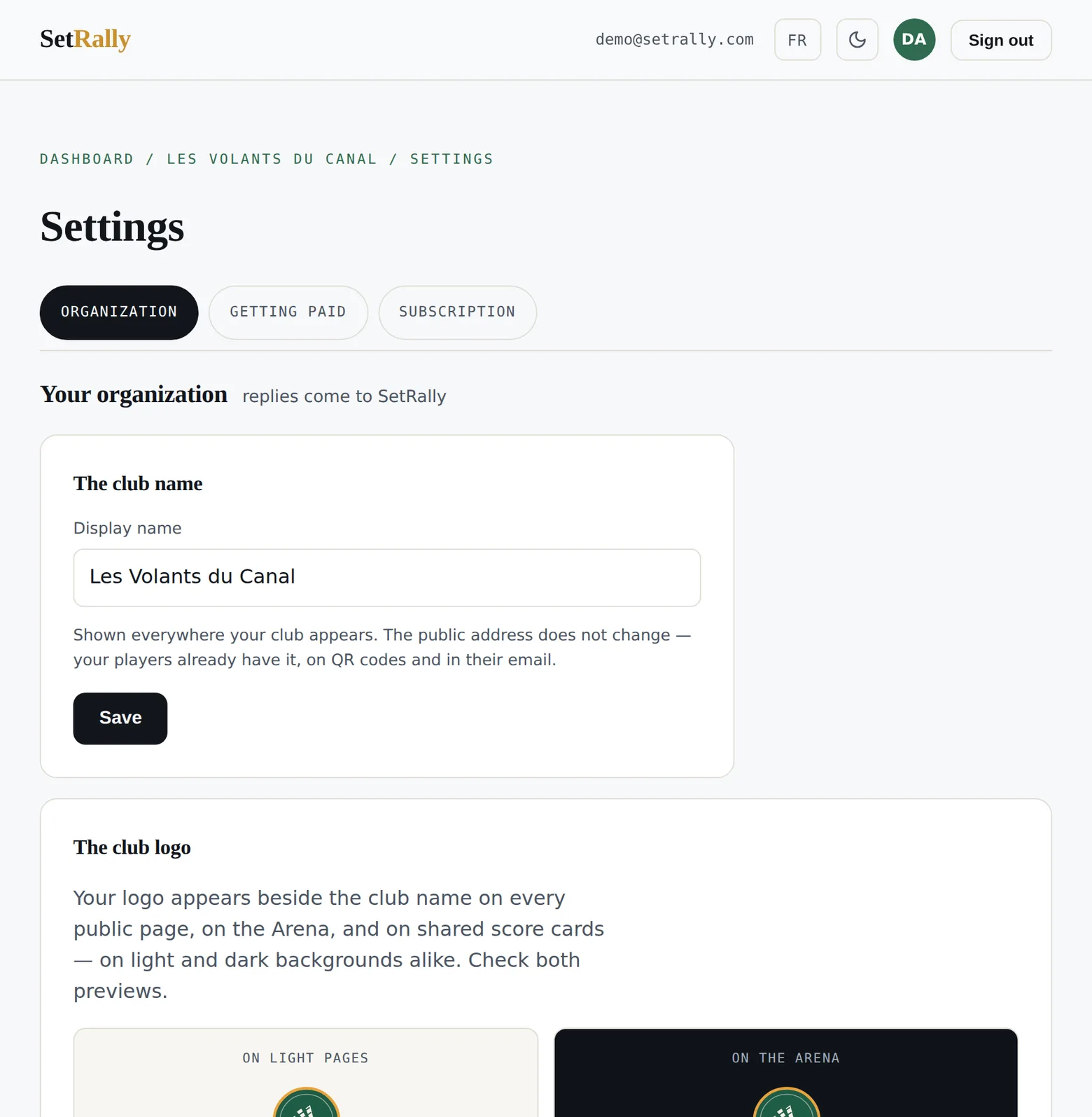
The club name
The display name can change at any time — a club merges, a league takes a sponsor's name. It updates everywhere: public pages, emails, the Arena, shared cards.
The public address does not move. That is deliberate: your players already have it, printed on QR codes and sitting in every email you have already sent. A club that changes its address breaks its own posters.
Your own address
On request, SetRally serves from behind your club’s domain — league.yourclub.com — and that is the address the Player link, its QR codes, the Arena (league.yourclub.com/live) and the invitation emails then carry. Your players only ever see the club’s name; the app.setrally.com/… address keeps working. Write to contact@setrally.com with the name you want: the hookup takes one DNS record on your side, nothing else.
The club’s time zone
Exactly one thing depends on it, and it matters: when the automatic invitations go out (chapter 3). “Three days before, at 9 a.m.” means 9 a.m. where your club plays, not 9 a.m. somewhere on a server.
You normally have nothing to do: the first time you turn automatic invitations on, SetRally reads your browser’s time zone and saves it here. The card tells you what time it is there right now — if that matches the clock on the gym wall, you are done. If not, pick your city from the list (the seven Canadian zones first, the rest of the world below) and save.
The club logo
Your logo appears beside the club name on public pages, on the Arena projected in the gym, and on the score cards your players share. One file, PNG or SVG: SetRally resizes it and trims the empty space around the artwork, so it fills the room reserved for it.
Two previews show it on light and on dark, exactly as the pages will. Look at both: here — not three weeks later in front of the gym — is where a problem must show up.
A dark artwork — most crests — automatically gets a thin paper-coloured outline, invisible on light pages, that keeps it readable on the Arena and in email read in dark mode: Gmail inverts the message’s background there, never the image, and a navy crest would vanish without it. The dark preview shows it as is. A light logo needs none and gets none.
Replies from your players
Every email sent for your club goes out in your club's name: a player sees “your club via SetRally” in their inbox. What remains is where their answer lands when they hit Reply.
Put your club's address here and invitations, pay links and confirmations will carry it. While it is empty, replies come to SetRally — we forward them, but on a game day that costs hours. The sign-in email always stays in SetRally's name: that one really is from us.
Who can run your organization
An organization can be run by several people, in two roles: administrator and manager. The rule fits in one sentence: managers run the events, administrators run the organization. A manager does everything about play — create and set up an event, register players, check people in, take cash at the door, send session invites. They touch nothing that belongs to the club itself: not the name, the logo, the time zone, the reply address, the tax numbers, the Stripe account, the subscription, or this list. That is the point: you hand a tournament to a volunteer without handing over the bank account.
A club can have several administrators — and should, so nobody is the only person who can fix something on a Saturday morning. An administrator can make a manager an administrator, do the reverse, remove someone, and anyone can leave an organization from their Your account page. The one thing that is impossible: removing or demoting the last administrator. An organization always keeps one.
To invite someone, open Settings → Members, type their email address, pick their role, send. They get a link good for 7 days, usable once; they do not need a SetRally account yet — the link has them create one on the way in. Until they accept, the invitation stays in the list and you can resend or cancel it.
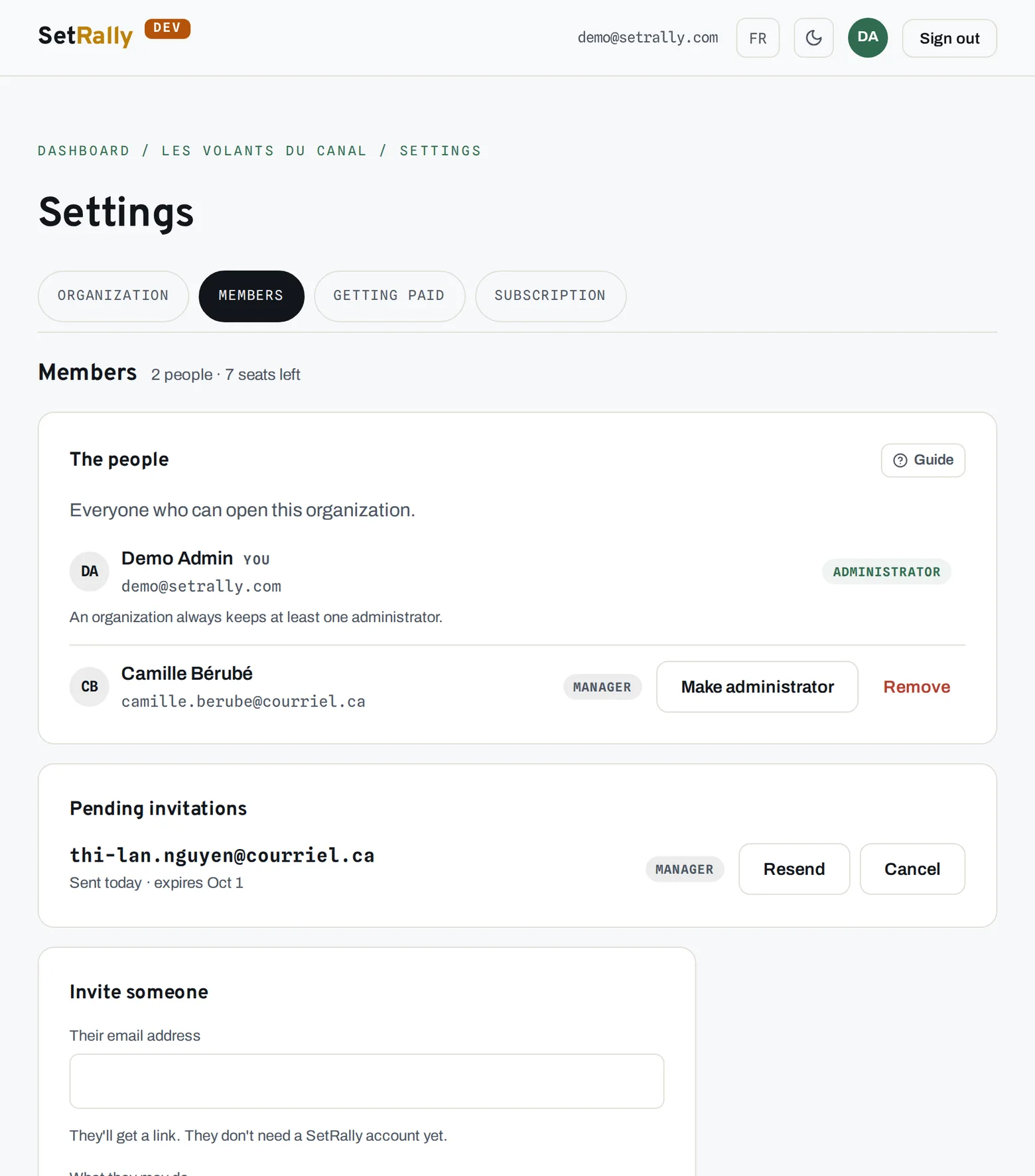
Inviting other people is part of Club (10 seats) and Pro (25 seats); on Free, one person runs the organization. Seats count administrators, managers and invitations not yet accepted — cancelling an invitation frees one right away.
Collecting online: the Stripe account
To take registration fees by card, the club connects its own Stripe account. Connect Stripe takes you there, you answer their questions — legal name, bank account, ID — and you come back. Budget about fifteen minutes, and keep your banking details at hand.
The money never passes through us. Every paid registration goes straight into the club's account; Stripe takes its card fee there (typically 2.9% + 30¢ in Canada) and SetRally its commission, which depends on the plan (3% on Free, 1% on Club, 0.5% on Pro): on a $100 registration on the Club plan, the club receives about $95.80. Players pay exactly the listed price. Receipts, refunds and transfers to your bank are managed from your own Stripe dashboard.
For the first few days Stripe accepts payments but holds the bank transfer while it finishes verifying. That is normal: sign-ups work, the money arrives a little later.
If Stripe asks for a document, a banner appears at the top of the page with its deadline. Don't ignore it: past that date payments stop, in the middle of a sign-up period. Check status re-reads your account when you have just settled something with them.
Disconnect this Stripe account cuts our end of the link only: Stripe keeps the account, its balance and its records. It is what you do when a club changes accounts, never to “tidy up”.
Your tax numbers
Your club is the seller, so your club collects and remits the tax, where it is registered. The numbers entered here print on your players' receipts — which is what lets them claim their input tax credits, and what an accountant will ask for one day. The note beside them says what is taxable, when your situation doesn't fit in a number.
Your SetRally subscription
The last group is the only one about money you pay us rather than money you collect. Three tiers: Free (one active event, 2 divisions, 16 players — the whole game engine, never crippled), Club (unlimited events, divisions and players, team leagues, up to 10 people) and Pro. A one-off tournament can also be paid à la carte, and it is free when its sign-ups run through SetRally. A session counts against none of these limits: it takes no active event and has no player cap.
Paying yearly amounts to two months free. Once subscribed, Manage subscription opens Stripe's secure portal: card, invoices, tier changes, cancellation — all without writing to us. Anything that raises the bill applies immediately, prorated; anything that lowers it takes effect at renewal, so you use what you already paid for.
On the Free tier nothing is deleted or closed: it is creation that stops — a second active event, a third division. Archiving a finished event frees the slot, and the archive keeps everything: results, standings, history. A one-off tournament has a way out of its own, with no subscription: the à-la-carte tournament, from its Settings → Plan — $49 once, or free when its sign-ups are paid online through SetRally. The panel above says so on the Free plan.